
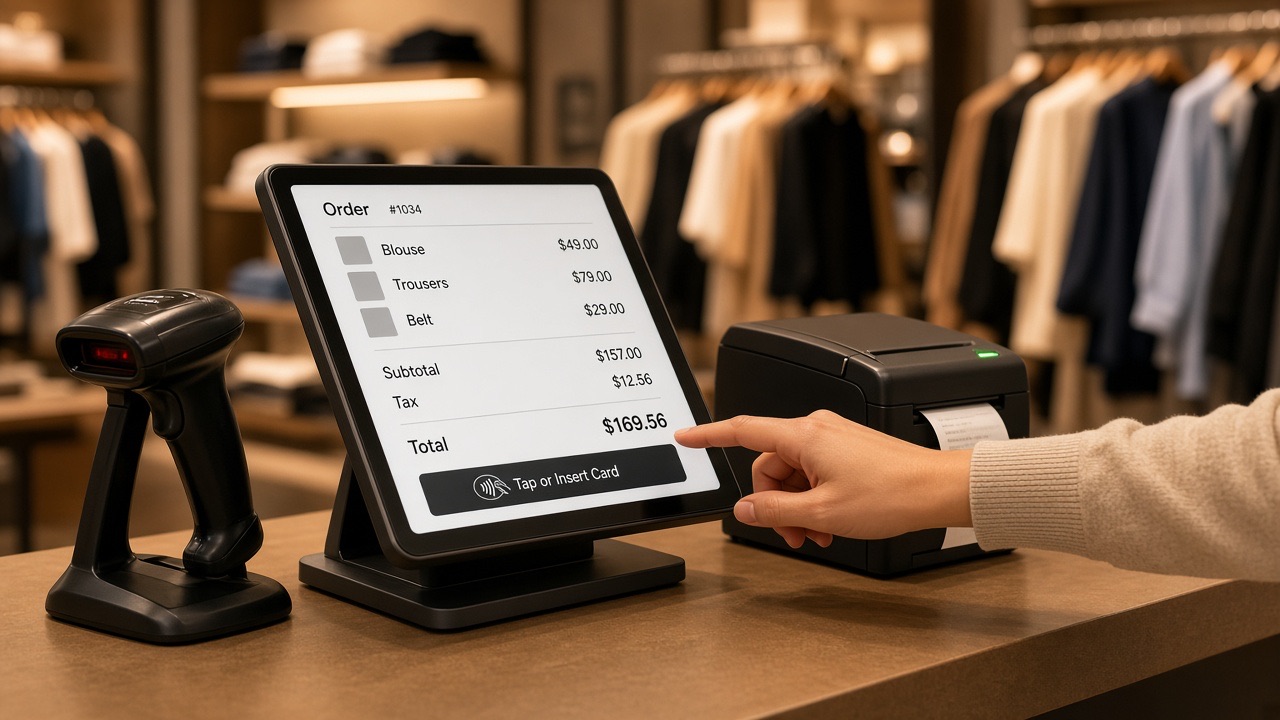
 Software
8 min read
POS Software for Retail in Pakistan: What Actually Matters
What a Pakistani retail or restaurant POS must do that cloud-only imports ignore — offline billing, tax invoices, multi-branch stock and Urdu receipts.
Read MoreReal-time invoice transmission to FBR, an IRN and a QR code on every receipt. What that means for the system you already run.

Written by a software engineer, not a tax adviser. Statutory references were checked against FBR's own published FAQs and the Sales Tax Act, 1990 on this date. WordbitX is not an FBR licensed integrator.
FBR digital invoicing means your billing system stops being a private record and becomes a reporting channel. Each sales tax invoice is transmitted to FBR's platform as it is raised, validated, and returned with a unique invoice reference number and a QR code that the buyer can verify. The paper you hand over is only the printed end of that round trip.
The obligation comes from SRO 709(I)/2025, dated 22 April 2025, issued under the Sales Tax Act, 1990 and rule 150Q of the Sales Tax Rules, 2006. FBR's own FAQ sets the integration dates at 1 June 2025 for corporate registered persons and 1 July 2025 for non-corporate registered persons, and later SROs have continued to widen the net. If you are sales tax registered, the question is not whether this applies but when it already did.
Two things businesses are routinely overcharged for are free. FBR charges no fee to a registered person for digital invoicing, and under rule 150XF, PRAL acts as a licensed integrator providing integration services at no cost. You pay for software, setup and support — not for access to the fiscal system.
The part that cannot be done by just anyone: only a licensed integrator, as defined in section 2(15A), may configure a registered person's invoicing software for real-time transmission to FBR. WordbitX is not a licensed integrator and does not claim to be. What we do is build or adapt the POS, ERP or e-commerce backend so it emits exactly the structured data the fiscal system expects, then work alongside PRAL or your appointed licensed integrator to get it transmitting.
This is where off-the-shelf foreign software tends to fail. QuickBooks, Xero, Zoho and most international ERPs were never designed around Pakistani sales tax: the JSON payload varies by scenario — exempt supplies, reduced-rate supplies, third schedule items, further tax on unregistered buyers — and HS code validation happens in real time against a local list. A compliance layer bolted onto software that does not model those concepts is where most failed integrations come from.
Rules, thresholds and dates in this area change with almost every finance act and SRO. Treat this page as an engineering brief, not tax advice, and confirm your own position with your tax adviser or FBR directly before acting.
Definitions do not ship products. These service pages explain the engagement.
POS, inventory and branch reporting that keep selling when the internet drops.
Storefronts, checkout and catalogue operations engineered for conversion — on Shopify or custom.
SoftwareWhat a Pakistani retail or restaurant POS must do that cloud-only imports ignore — offline billing, tax invoices, multi-branch stock and Urdu receipts.
Read More Software
A decision framework for choosing between off-the-shelf SaaS and custom development — including the total cost picture most comparisons ignore.
Read MoreNot directly, and anyone telling you they do without a licence is overstating. Only an FBR licensed integrator under section 2(15A) may configure your software for real-time transmission. We build the software so it produces compliant invoice data and we work with PRAL — which provides integration free of cost under rule 150XF — or with whichever licensed integrator you appoint.
Nothing. Per FBR's own FAQ, a registered person pays no fee to FBR, and PRAL provides integration services free of cost. Your costs are the invoicing software, configuration, and any fee a private licensed integrator charges — which FBR caps by general order.
The centrally generated unique invoice number, a verifiable QR code and the FBR logo, alongside seller NTN and STRN, buyer details, item description with HS code and unit of measurement, quantity, value excluding tax, the sales tax amount, and value including tax. Further tax and withheld tax appear where they apply.
Your software should queue and retry rather than stop the counter. That is an architectural requirement we design for from the start — an offline-capable local layer with a conflict-safe sync, so trading continues and invoices reconcile when the connection returns.
Often yes. If it exposes a clean data layer we add a compliance service alongside it rather than replacing it. If it is a closed foreign product with no Pakistani tax model, replacing the invoicing path is usually cheaper than fighting it. We tell you which of the two you are looking at during discovery.
Real-time reporting from the till, an FBR invoice number and QR code on every receipt, and a counter that keeps selling when the line drops.
Section 2(43A) catches far more shops than owners expect. Meeting any one test is enough — including the electricity bill.
Restaurants, cafés and snack bars have their own rule. Dine-in, takeaway, delivery and aggregator orders all have to reconcile.
Tell us the workflow. We will recommend a package, a custom build, or neither.
Typical reply time: same business day. We work with clients across Pakistan, the UK, US, UAE and Australia.
