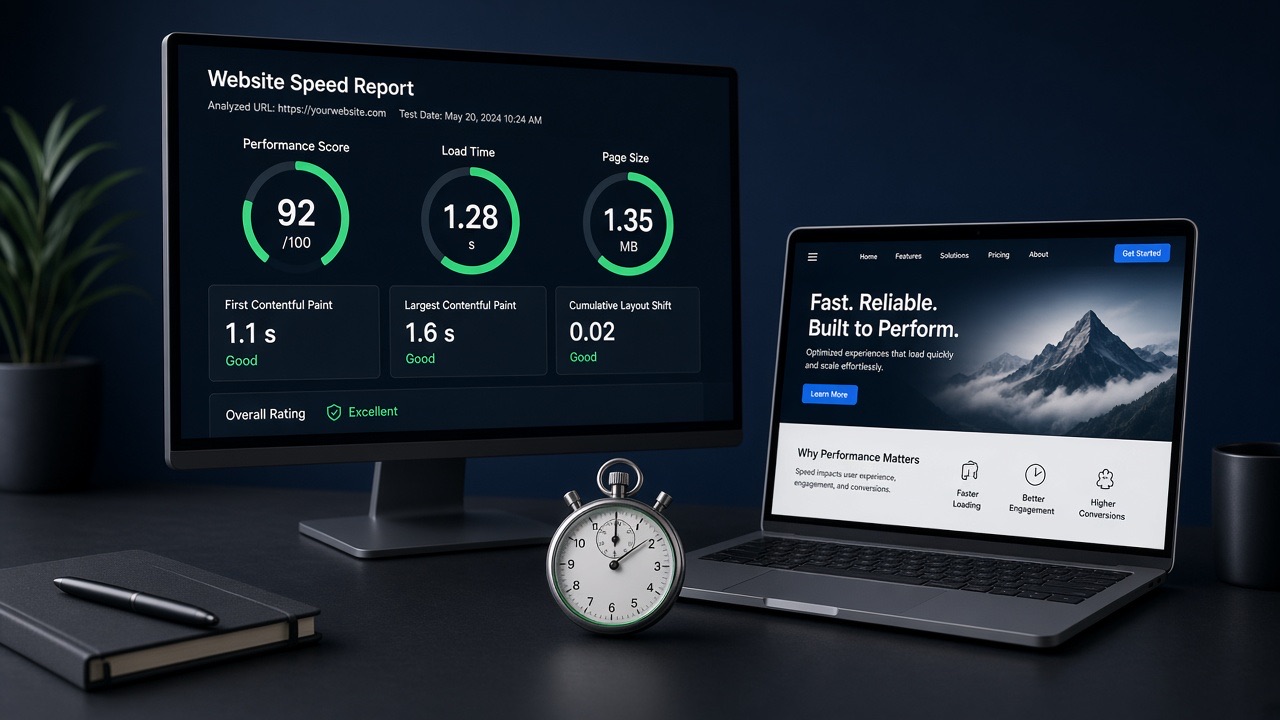
Slow pages lose users first and rankings second. Google's Core Web Vitals are a ranking signal, but the commercial reason to care is simpler: people bounce from pages that take more than a couple of seconds to become usable, especially on mobile.
Measure before you guess
- PageSpeed Insights and CrUX field data — not just lab scores.
- Search Console → Core Web Vitals report for real-user data.
- Lighthouse on a throttled mobile profile.
The speed fixes that usually matter
- 1Serve modern image formats (AVIF/WebP) at the right size. Do not ship a 4000px hero to a phone.
- 2Lazy-load below-the-fold images. Never lazy-load the LCP image.
- 3Cut unused JavaScript. Page builders and marketing tags are the usual villains.
- 4Use server rendering or static generation for anything that must rank.
- 5Cache HTML and assets at the edge (Cloudflare or similar).
- 6Preload the hero font and the LCP image.
The SEO fixes that usually matter
- One clear H1, logical H2/H3, unique title and meta description per page.
- Canonical tags that match the URL you want indexed.
- XML sitemap listed in robots.txt, containing only canonical URLs.
- No accidental noindex on money pages.
- Internal links with descriptive anchors — see our SEO services.
- Valid schema that matches visible content.
A two-week improvement plan
- 1Week 1: images, fonts, render-blocking scripts, LCP element.
- 2Week 2: titles, headings, internal links, sitemap, Search Console cleanup.
- 3Then: content that answers commercial queries, not more plugins.
Want a technical audit that ends in shipped fixes, not a PDF? Talk to WordbitX.
Need help applying this?
WordbitX turns guidance like this into delivered work — scoped, built and supported. Email info@wordbitxtech.com or send your brief through the contact form.